When travel companies compare flight APIs, they usually compare search: airline coverage, speed, the look of the documentation. Those things matter, but they are not where agencies lose money or customers. That happens after the ticket is issued, when a traveler wants to cancel, change a date or get a refund, or when the airline moves the flight.
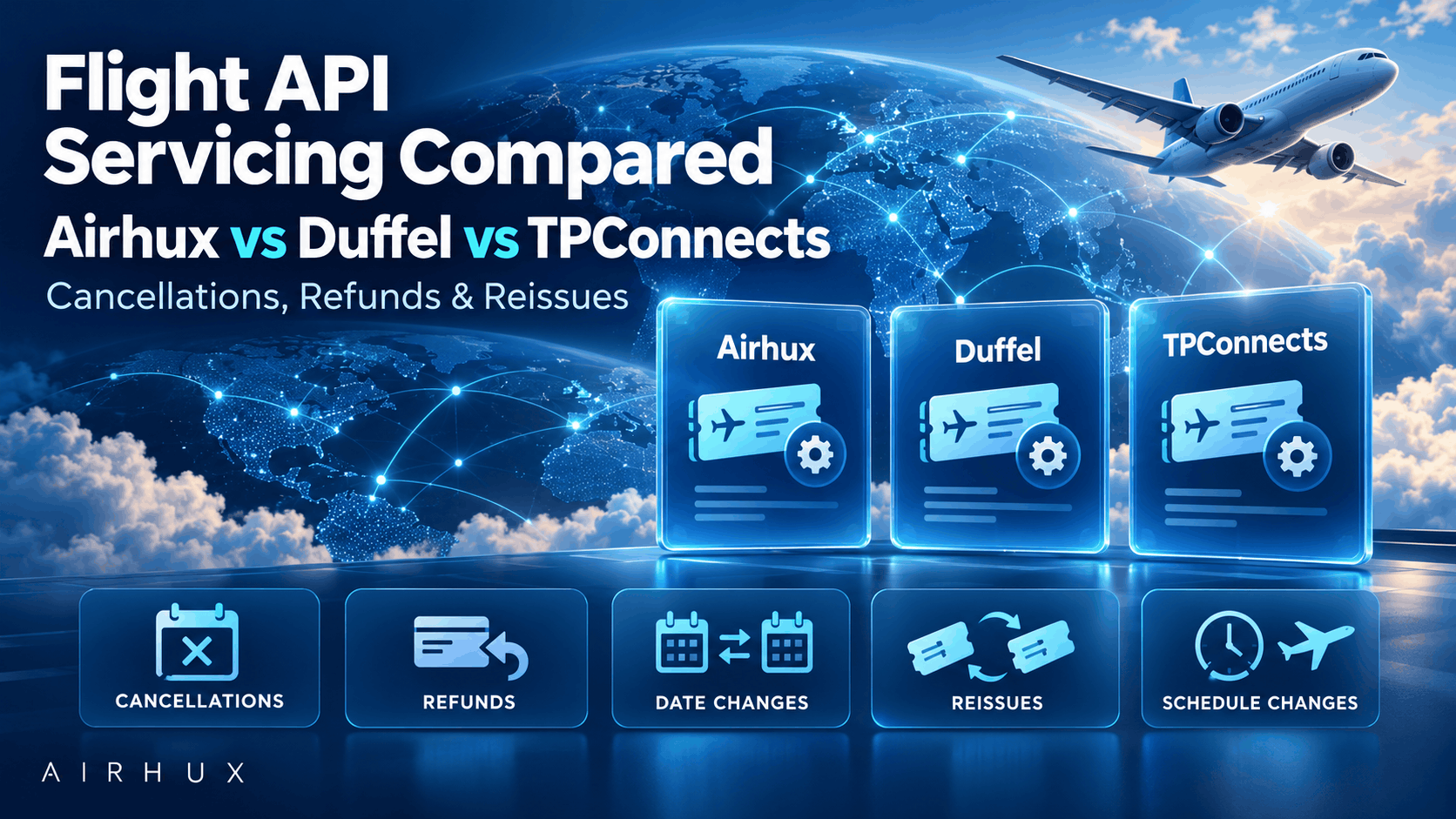
This article compares how three providers approach servicing: Airhux, Duffel and TPConnects. It is based on each provider's public documentation and announcements as of October 2026. Capabilities change, so confirm the details with each provider for your airlines and markets before you decide.
The Three Providers in Brief
- Duffel is a developer-focused flight API built mainly on airline NDC and direct connections, known for clean documentation and a fast start.
- TPConnects is an NDC aggregator and technology provider that connects agencies and platforms to many airlines' NDC channels.
- Airhux is a travel technology company whose Travel API combines GDS and airline NDC content with a full servicing desk, inside a multi-tenant platform for B2C, B2B and agent channels.
All three can search and book flights. The differences show up in what happens next.
Why Servicing Is Hard for Any Flight API
Servicing is hard because the provider is not the airline. Every cancellation, refund or change depends on:
- The fare rules the traveler bought, which may allow or forbid changes and refunds.
- The airline's own capabilities in the channel used. Many airlines expose booking through NDC long before they expose changes or refunds.
- The channel itself. On the GDS, the agency issues and refunds the ticket through BSP or ARC. On NDC, the airline issues the ticket and controls servicing.
- Unknown outcomes. A timeout during a change or refund may or may not have gone through at the airline.
So the real question is not "does the API have a refund endpoint?" It is "what happens for my airlines, on my fares, when automation is not available?"
How Duffel Handles Servicing
Duffel's documentation describes a clear, API-first model:
- Conditions: offers and orders carry conditions that tell you whether a change or refund is allowed before departure.
- Cancellations: you create an order cancellation to get a refund quote, then confirm it. The quote expires, and only the most recent quote can be confirmed. Duffel's v2 migration notes say a refund amount can be returned as unknown when the airline cannot give a quote.
- Changes: Duffel's own guide says changes "are not available for all orders"; you check the order's available actions before offering one.
- Airline-initiated changes: Duffel's help centre says only a few airlines allow these to be accepted, changed or cancelled automatically; for others, you contact Duffel to have them processed.
What this means in practice: where an airline supports servicing through Duffel, the flow is clean and well documented. Where it does not, your team needs a fallback: a support request, an email, a manual process. Build that fallback before launch, not after the first angry traveler.
How TPConnects Handles Servicing
TPConnects focuses on NDC distribution. Its announcements describe exchanges, refunds and cancellations on its platform, and it publishes airline-by-airline integration news listing servicing features such as void and refund.
As with any NDC aggregator, servicing depends on what each airline has built in its NDC channel. Airline partner updates, such as those published for travel agents by some carriers, show servicing features rolling out over time and sometimes listed as "in progress".
What this means in practice: check the servicing matrix for each airline you sell, not the headline list of connected airlines. An airline that books through NDC may not yet support reissue or refund in that channel.
How Airhux Handles Servicing
Airhux was designed on the assumption that not every servicing action can be automated, and that every request still needs an owner. Instead of offering an endpoint and leaving the rest to you, each servicing request becomes a tracked case.
- Void: within the void window, the ticket status is checked with the airline before the customer's money is returned.
- Cancellation: unticketed bookings are cancelled directly; ticketed bookings become cancellation requests with fare rules and penalties visible to staff.
- Refunds, both sides: the airline refund is processed through the GDS refund process with the penalty applied and the refund total confirmed by a person; the customer refund is quoted, approved and paid back by card or wallet, and only after the airline side is done.
- Date changes and reissue: the traveler picks a new flight, sees the difference plus any change fee, and pays online. The servicing desk makes the change with the airline and the booking is updated when it is confirmed.
- Schedule changes: airline queues are read in the background; each change is raised once, recorded on the booking timeline and listed for action.
- Unknown outcomes: money stays on hold and the case goes to a person. Nothing is retried blindly.
What this means in practice: there is always a next step. When an airline cannot be serviced automatically, the request does not disappear into an inbox; it appears on the action list with the money and the airline record side by side.
Side-by-Side Comparison
Content
- Duffel: NDC and direct airline connections.
- TPConnects: NDC aggregation.
- Airhux: GDS and airline NDC combined in one format.
Cancellation
- Duffel: quote, then confirm through the API, where the airline supports it.
- TPConnects: depends on each airline's NDC servicing.
- Airhux: direct for unticketed bookings; a tracked request with fare rules for ticketed ones.
Refund
- Duffel: the quote can be unknown when the airline gives none.
- TPConnects: depends on each airline's NDC servicing.
- Airhux: airline side through the GDS refund process with a person-confirmed total, then the customer refund.
Date Change and Reissue
- Duffel: only for orders that offer a change.
- TPConnects: depends on each airline's NDC servicing.
- Airhux: the traveler pays the difference online and the servicing desk makes the change.
Airline Schedule Changes
- Duffel: automatic for a few airlines, others through Duffel support.
- TPConnects: depends on the airline.
- Airhux: detected from airline queues, raised once and listed for action.
When Automation Is Not Available
- Duffel and TPConnects: contact the provider's support.
- Airhux: a built-in action list, booking timeline and staff alerts.
Agents, Wallets and B2B
- Duffel: you build it yourself.
- TPConnects: varies by product.
- Airhux: included in the platform.
Questions to Ask Any Flight API Provider
Before you sign, ask each provider these questions for the airlines you sell most:
- Which servicing actions work automatically for this airline: void, cancel, refund, change, reissue?
- What happens when the airline gives no refund quote?
- Who handles airline schedule changes, and how am I told?
- How is a timeout during booking, change or refund resolved?
- Where does the refund money go, and when?
- Is there a screen for my staff, or only an API and a support email?
- Can my agents service their own bookings without seeing other agents' bookings?
The answers tell you more about your future support workload than any search benchmark.
Which Provider Fits Which Business
- Duffel suits developer teams building a modern flight product who are comfortable building their own servicing fallbacks and support processes.
- TPConnects suits companies focused on NDC distribution who want access to many airlines' NDC channels.
- Airhux suits travel agencies and B2B travel companies that want GDS and NDC content with servicing, agents, wallets and staff workflows already in place.
Frequently Asked Questions
Is Duffel bad at refunds?
No. Duffel offers a well-documented cancellation and refund flow. Like every NDC-based provider, what it can do depends on each airline, so some cases need a manual fallback through support.
Is Airhux servicing fully automatic?
Not for every case, and it does not pretend to be. Steps that move money at the airline, such as processing a refund total or confirming a change, are confirmed by a person. In exchange, every request is tracked until it is finished.
Can I switch providers later?
Yes, but servicing is what makes switching hard: existing bookings must still be serviced where they were made. Choose with servicing in mind from day one.
Where can I learn the basics first?
Read our guides on GDS vs NDC and the flight booking API lifecycle.
Sources
- Duffel: Cancelling an order, Changing an order, Offer and order conditions, Migrating from v1 to v2
- TPConnects: What's new at TPConnects, EGYPTAIR NDC integration
How Airhux Can Help
If servicing is what keeps your team up at night, talk to us. The Airhux Travel API gives you GDS and NDC content with a servicing desk built in. Start your project and tell us which airlines and markets you sell.
- Duffel alternative
- TPConnects alternative
- Duffel vs TPConnects
- flight API comparison
- flight cancellation API
- flight refund API
- ticket reissue API
- NDC aggregator
- flight servicing API