"The customer wants to cancel" can mean four different things in a travel agency, and each one has its own rules, deadlines and money flow. Mixing them up is one of the most common ways agencies lose money: refunding a customer for a ticket the airline never refunded, or missing a void window that would have cost nothing.
This guide explains each operation in plain language and how a good system should handle it.
The Booking and the Ticket Are Different Things
Before anything else, separate two records:
- The booking (PNR or airline order): the reservation that holds seats on the flights.
- The ticket (e-ticket): the document that pays for those seats and lets the traveler fly. It has its own number and its own status.
A booking can exist without a ticket. A ticket can be refunded while the booking record still exists. Servicing always asks: what state is the ticket in?
Cancel: Releasing an Unticketed Booking
Cancelling an unticketed booking simply releases the seats. No ticket exists, so no money has been settled with the airline.
- It is usually free, because nothing was issued.
- Held bookings should be cancelled before the airline's ticketing deadline, or the airline will cancel them itself.
- If the customer paid you already, refund them in full, unless your own fees say otherwise.
When people say "cancel" about a ticketed booking, they usually mean one of the next two operations.
Void: Undoing a Ticket on the Same Day
A void cancels a ticket as if it had never been issued. It is only possible within a short window, typically the same day as issue under BSP or ARC rules, and before the first flight.
- No airline penalty applies, because the sale is reversed.
- The ticket status must actually change at the airline. Always check that the ticket is no longer active before refunding the customer.
- Not every ticket can be voided: some airlines and some NDC orders do not allow it, and documents issued on other days cannot be voided.
A void is the cheapest outcome for everyone, so a system should offer it first whenever the window is open.
Refund: Returning Money for an Unused Ticket
After the void window, a cancelled ticket must be refunded. A refund has two separate sides:
- The airline side. The agency asks the airline, through BSP or ARC on GDS tickets or through the airline on NDC orders, to refund the unused value, minus the fare's cancellation penalty. Taxes may be refundable even when the fare is not.
- The customer side. The agency returns money to the customer: what the airline refunded, adjusted for the agency's own fees.
The golden rule: do not pay the customer before the airline side is done, or you risk paying out money you will never get back.
Our flight refund guide goes into penalties, taxes and timelines in more detail.
Reissue (Exchange): Changing a Ticketed Booking
A reissue replaces the ticket with a new one for different flights, usually a different date or time.
- The new fare is compared with the old one. The traveler pays any difference plus the airline's change fee.
- A cheaper new flight often does not create a refund; many fares keep the residual value or lose it.
- The booking must be updated with the airline first; the new ticket is then issued against it.
- Some fares do not allow changes at all.
From the customer's point of view, this is a "date change". From the agency's point of view, it is a rebook plus a reissue, and both steps must succeed.
What About Airline Schedule Changes?
When the airline changes the flight, the rules are different. Depending on the size of the change, the traveler may accept it, move to another flight or get a refund, often without penalty. See our guide on handling airline schedule changes.
Quick Reference
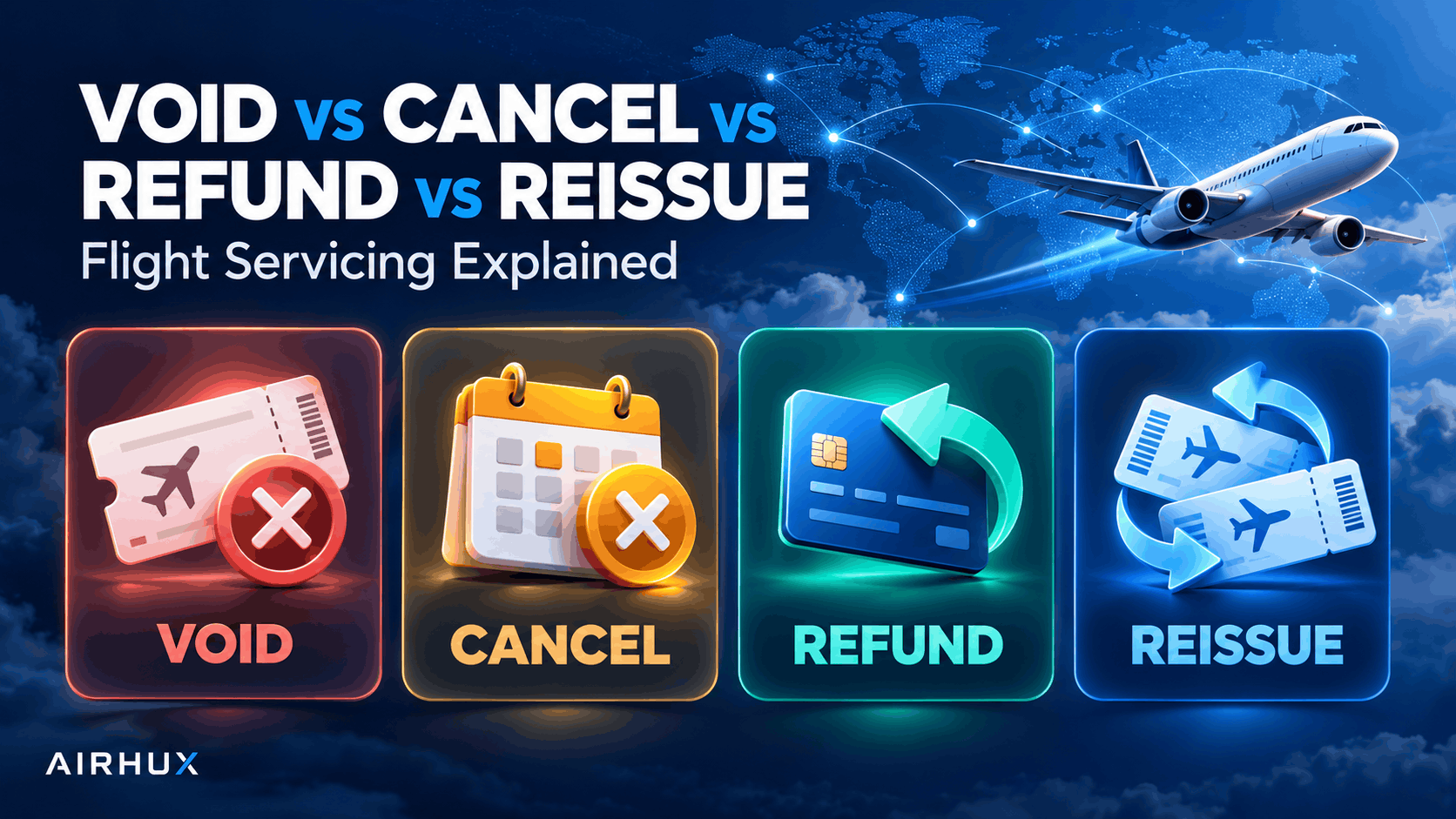
- Cancel: unticketed booking, no settlement, usually free.
- Void: ticket issued today, reversed in full, no penalty, short window.
- Refund: ticket past the void window, airline refund minus penalty, then the customer refund.
- Reissue: new flights on a new ticket, traveler pays the difference plus fees.
Common Mistakes
- Refunding the customer before the airline confirms its refund.
- Missing the void window and paying a penalty that could have been avoided.
- Assuming a cancelled booking means a refunded ticket.
- Charging a change fee without checking the fare allows changes.
- Retrying a refund or change after a timeout and doing it twice.
- Handling servicing in email with no record of who did what.
How a Good System Handles Servicing
- Offer a void automatically while the window is open.
- Show the fare rules and penalty before staff decide.
- Keep the airline refund and the customer refund as separate, linked steps.
- Let the customer pay for a change online before the change is made.
- Give every request a status, an owner and a timeline.
- Send unknown outcomes to a person instead of guessing.
Frequently Asked Questions
Can a customer void their own ticket?
On a well-built platform, yes, within the window and for their own booking. The system should check the ticket status with the airline before releasing money.
Why is my refund smaller than the ticket price?
Because the airline keeps the fare's cancellation penalty, and some fees are non-refundable. Taxes are often refundable even on non-refundable fares.
Is a date change a refund plus a new booking?
No. It is a reissue: the old ticket's value is applied to the new one, and only the difference and fees are paid.
How Airhux Can Help
The Airhux Travel API and white-label platform include voids, cancellations, two-sided refunds, paid date changes and schedule-change alerts, each tracked from request to completion. Start your project to see it in action.
- void vs refund
- void a flight ticket
- cancel flight booking
- flight ticket refund
- ticket reissue
- flight exchange
- flight servicing
- travel agency servicing
- BSP refund
- ARC void