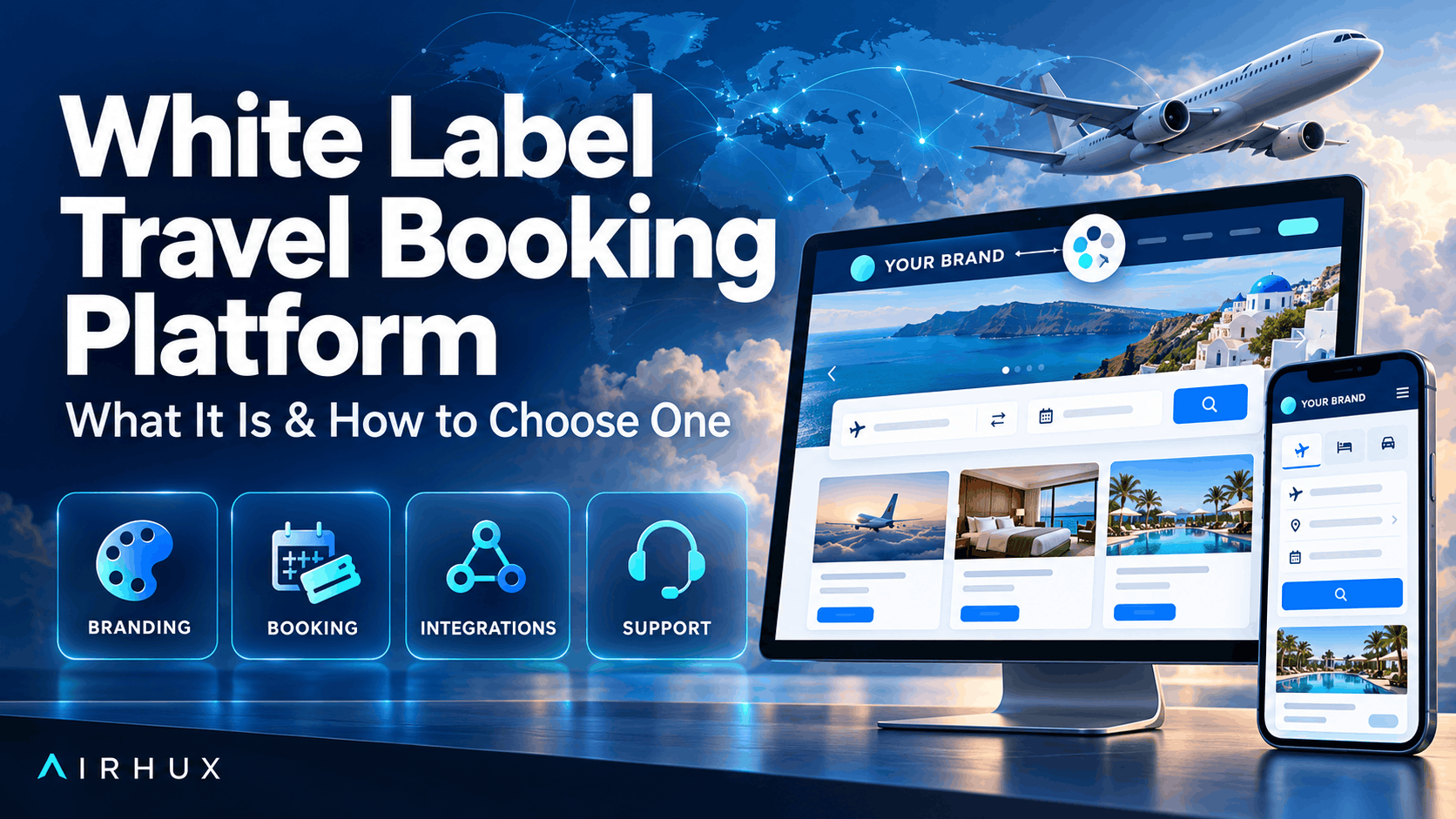
A white label travel booking platform is ready-made booking technology that a travel agency runs under its own brand. The provider builds and maintains the booking engine, content connections and admin tools; the agency puts its name, domain and colors on it and sells to its own customers.
For most agencies, the question is not whether white-label can work but which platform fits their business. This guide explains what to look for, which questions to ask vendors, and when a custom build makes more sense.
1. What a White Label Travel Booking Platform Includes
A complete platform usually covers three layers.
- Storefront: the customer-facing website where travelers search, compare, book and pay.
- Booking engine and content: the connections to airlines and other suppliers, plus pricing, booking and ticketing logic.
- Back office: the admin where staff manage bookings, customers, agents, pricing rules, payments and settings.
Some platforms are only a search widget that sends customers elsewhere. That is not the same thing. If the booking, payment and customer record do not belong to your agency, you are running an affiliate site, not an agency.
2. Your Own Domain and Branding
The point of white-label is that customers see your brand, not the provider's.
- Your storefront should run on your own domain.
- You should control your logo, theme and brand colors from your admin without a support ticket.
- Emails, booking confirmations and documents should carry your brand.
- Content pages such as about, terms and contact should be editable by you.
Ask to see a live storefront run by an existing customer, and check whether any provider branding appears to travelers.
3. Content Breadth
A booking platform is only as useful as the content behind it. For flights, ask whether the platform offers GDS content, airline NDC content or both. Many agencies need both to cover the airlines and fares their customers want. See our article on GDS vs NDC for why.
- Which airlines and routes are covered for your market?
- Are branded fares, bags and seat selection available where the airline supports them?
- What products beyond flights are included, such as visas, car rental or airport transfers?
- How often is content updated, and what happens when a supplier changes its system?
4. B2C and B2B in One Platform
Many agencies sell both to travelers and to other agents. A platform that handles both channels avoids running two systems.
- A B2C site for the public, with customer accounts and booking history.
- A B2B workspace for travel agents, with sign-up and approval, agent wallets or credit, and agent-specific pricing.
- Clear ownership so each agent sees only their own bookings.
A well-designed agent workspace is often what turns a B2C site into a wider distribution business.
5. Payments, Wallets and Markups
Check exactly how money moves through the platform before you sign.
- Can you use your own payment gateway account, so customer payments reach your business directly?
- Does the platform authorize payment before booking and capture only after success?
- Are wallets supported for agents and repeat customers?
- How are refunds returned, and to which payment method?
- What fraud controls are in place, such as bot protection on payment steps and contact validation?
Your margin should be in your hands. Look for markup rules you can set yourself by product, route, airline, cabin or customer type, with separate rules for B2C and B2B. Ask how prices are displayed to customers and whether taxes and fees are shown clearly, since many places have rules about advertising full prices.
6. Servicing Tools
Servicing is where agencies spend most of their staff time. A strong platform gives your team the tools to handle what happens after the sale.
- A booking timeline showing payments, ticketing, changes and messages.
- Support for cancellations, voids, refunds and date changes, with clear rules on who may do what.
- A queue of bookings that need attention, so nothing is missed.
- Your own fees for changes, cancellations and refunds.
- Customer self-service for common requests where appropriate.
7. SEO Control
If you want organic traffic, you need control over how search engines see your site.
- Editable titles and meta descriptions per page.
- A sitemap and robots settings you can manage.
- Fast pages that work well on mobile.
- The ability to publish your own content and blog articles.
Avoid platforms that generate thousands of thin, templated pages. Search engines tend to reward useful pages, not volume.
8. Questions to Ask Vendors
- Who owns the customer data, and can we export it?
- Which content sources are included, and which cost extra?
- What does onboarding involve, and who approves our account?
- How are changes, refunds and airline schedule changes handled?
- What can we configure ourselves, and what needs the vendor?
- How do you handle security, payment data and access control?
- What happens to our bookings and data if we leave?
- How are fees structured, and are there per-booking charges?
9. White-Label vs Custom Build
A custom build gives you complete control over features and roadmap. It also means integrating content, passing supplier certifications, building payment and servicing logic, and maintaining all of it. This suits companies with an unusual business model, a large budget and a long-term technical team.
White-label suits most agencies that want to launch quickly and focus on sales and service. Some agencies start on white-label and later commission custom features or integrations around it. Our guide on custom software vs off the shelf covers that decision in general terms.
Common Mistakes to Avoid
- Choosing a platform on the demo storefront alone without testing the admin.
- Not checking whether the content covers your key routes and airlines.
- Accepting a platform where payments flow through the vendor without clear settlement terms.
- Ignoring servicing tools until the first refund request arrives.
- Forgetting to ask about data ownership and exit terms.
- Launching without your own SEO settings and content plan.
Frequently Asked Questions
Is a white label travel booking platform the same as an affiliate site?
No. An affiliate site sends travelers to another company to book, and you earn a commission. A white-label platform lets you take the booking and payment under your own brand, so the customer relationship belongs to you.
Can I use my own domain?
You should be able to. A proper white-label platform runs your storefront on your own domain with your branding. Ask the vendor to confirm this before signing.
Do I need my own airline accreditation?
It depends on how the platform issues tickets and on the rules where you operate. Ask the vendor how ticketing works on their platform and research the accreditation and seller-of-travel rules in your jurisdiction.
How long does it take to launch on white-label?
Usually much faster than a custom build, because the booking engine already exists. Your timeline depends mainly on approval, branding, content setup and payment gateway configuration.
Can I sell to travel agents as well as travelers?
On platforms that include a B2B workspace, yes. Check that agents get their own sign-up, approval, wallets and pricing rules.
How Airhux Can Help
The Airhux Travel SaaS Platform is a white-label online travel booking platform for travel agencies. Each agency gets its own branded storefront on its own domain, with theme and brand colors chosen in its admin, a B2C customer site and a B2B travel-agent workspace. It includes flight search and booking with worldwide airline content from GDS and airline NDC sources, plus visa applications, car rental, airport transfers, agency wallets, markup rules and an admin to service bookings.
Agencies sign up and are approved by Airhux. To get started, become a travel partner. If you need custom features or integrations on top, start your project.
- white label travel booking platform
- white label travel website
- white label booking engine
- travel agency software
- B2B travel portal
- online travel agency software
- white label flight booking
- travel booking engine